
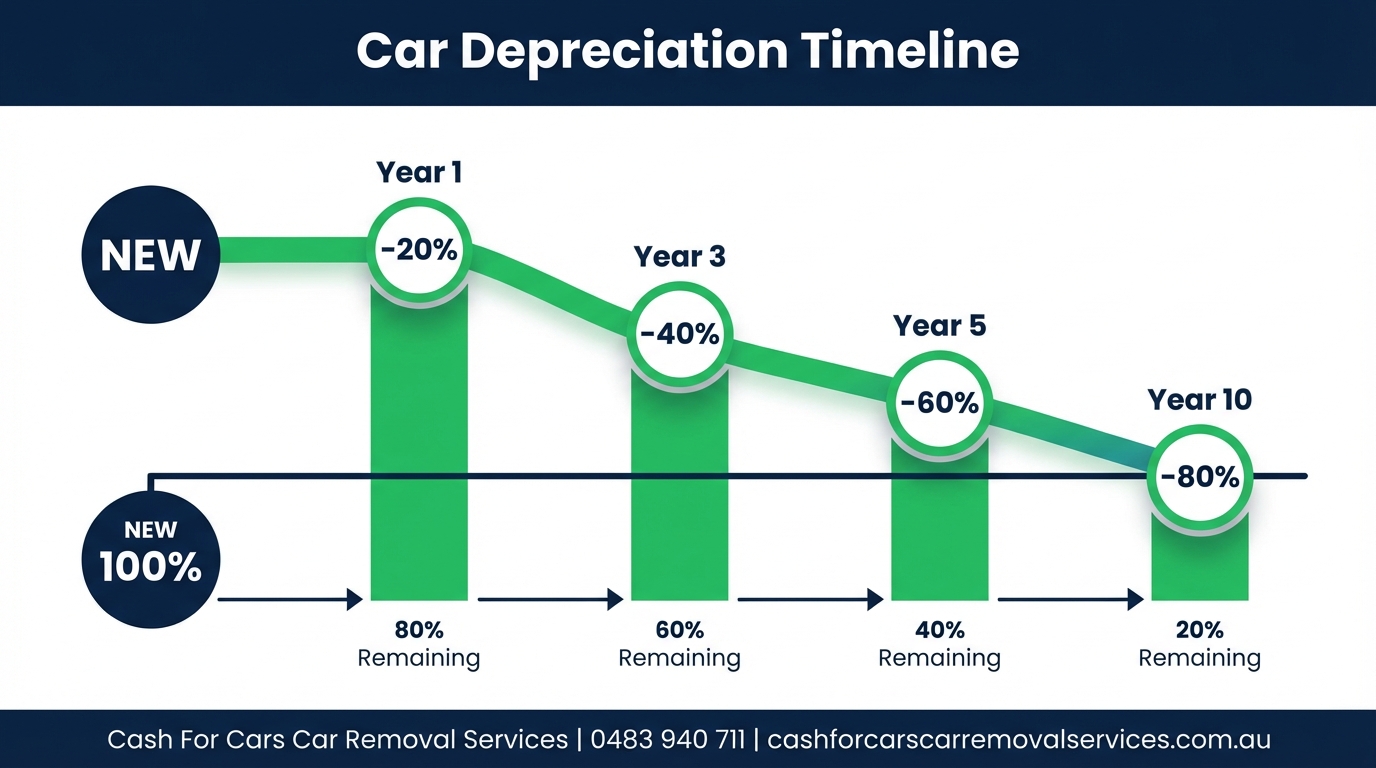
The Depreciation Curve
How Cars Lose Value
Every new car begins depreciating the moment it's driven off the lot. Understanding this curve helps you make informed selling decisions.
Typical Depreciation Timeline
Year 1: 15-25% loss
The biggest hit happens immediately. A $50,000 new car might be worth $37,500-$42,500 after one year.
Years 2-3: 10-15% per year
Depreciation slows but remains significant.
Years 4-5: 8-12% per year
The curve flattens as the car matures.
Years 6-10: 5-8% per year
Slower depreciation continues.
Beyond 10 years: Variable
Condition, mileage, and desirability become more important than age.
When Does Depreciation Slow?
The Sweet Spot
Many vehicles hit a "depreciation floor" where value stabilizes:
- Economy cars: 8-12 years
- Mid-range sedans: 7-10 years
- Luxury vehicles: 10-15 years
- 4WDs/Utes: 8-12 years
- Sports cars: Varies widely
- Age matters less
- Condition becomes critical
- Mileage is key
- Maintenance history crucial
- Toyota Land Cruiser
- Toyota HiLux
- Mazda BT-50
- Subaru Outback
- Porsche 911
- Luxury European sedans
- Large American SUVs
- High-end electric vehicles (currently)
- Performance variants
- Under 15,000 km/year: Above average value
- 15,000-20,000 km/year: Average
- Over 20,000 km/year: Below average
- Excellent: Can exceed expected value
- Good: Within expected range
- Fair: Below expected value
- Poor: Significantly below expected
- Full dealer history: Premium value
- Partial records: Average
- No history: Discount applied
- Avoiding out-of-warranty repair costs
- Still in high-demand age bracket
- Before major scheduled service
- Maximizing trade-in value
- Initial depreciation absorbed
- Still attractive to buyers
- Generally reliable period
- Reasonable running costs
- May be below finance lending age
- Fewer private buyers
- Cash for cars increasingly attractive
- Condition trumps age
- Make and model demand
- Current condition
- Running status
- Mileage relative to age
- Local market conditions
- Service history
- Previous damage
- Modifications
- Missing parts
- Documentation
- Classic cars (25+ years)
- Modern vehicles (under 5 years)
- Everything in between
- Running or not
- Maintain dealer service history
- Keep all documentation
- Fix small issues
- Clean presentation
- Address major maintenance
- Consider private sale for popular models
- Cash for cars for less popular models
- Document any work done
- Focus on running condition
- Don't over-invest in repairs
- Cash for cars often best option
- Value stability reached
- Current market value
- Upcoming maintenance costs
- Your timeline
- Replacement plans
- Guaranteed price
- Immediate payment
- No preparation needed
- Any condition accepted
- Higher potential price
- Time investment required
- Presentation matters
- Condition critical
Value Plateau
At this point:
Best vs Worst Depreciators
Strong Value Retention
These brands/models hold value best:
Faster Depreciation
These lose value more quickly:
Factors Beyond Age
Mileage Impact
Condition Categories
Service History
Best Time to Sell by Age
3 Years (End of Warranty)
Consider selling when:5-7 Years
Good balance of:10+ Years
Considerations:How We Value Older Vehicles
Our Assessment Factors
When evaluating your vehicle, we consider:
Primary Factors:
Secondary Factors:
Age Isn't Everything
At Cash For Cars, we buy vehicles of all ages:
Maximizing Value at Any Age
Under 5 Years
5-10 Years
Over 10 Years
Making the Decision
Calculate Your Position
Consider:
Quick Sale vs Maximum Return
Quick Sale (Cash for Cars):Maximum Return (Private/Auction):
Get Your Vehicle Valued
Whatever your car's age, we provide free, no-obligation valuations. Call 0483 940 711 today and find out what your vehicle is worth right now - no guesswork required.