
The Rise of Electric Vehicles in Australia
Electric vehicle adoption in Australia has accelerated dramatically. As early EVs reach end-of-life and batteries degrade, understanding the recycling process becomes essential for all EV owners.
What Makes EV Recycling Different?
The Battery Challenge
EV batteries are:
- Large and heavy — 300-700kg typically
- Complex — multiple cells, cooling systems, electronics
- Valuable — contain lithium, cobalt, nickel, manganese
- Potentially hazardous — high voltage, fire risk if damaged
- Powers the vehicle for 8-15 years
- Typically replaced when capacity drops below 70-80%
- Average: 150,000-300,000 km before replacement needed
- Batteries retired from vehicles still have significant capacity
- Used for:
- Can extend useful life by 5-10 years
- Batteries shredded after discharging
- Materials separated mechanically
- Plastics, metals recovered
- Chemical processes extract metals
- Lithium, cobalt, nickel recovered at high purity
- Can recover 95%+ of valuable materials
- High-temperature smelting
- Recovers cobalt, nickel, copper
- Less efficient for lithium recovery
- Limited specialised facilities
- High transportation costs
- Evolving battery chemistries
- Regulatory framework still developing
- New recycling facilities opening (NSW, VIC)
- Battery stewardship schemes developing
- Increasing investment in recycling technology
- Growing expertise in safe handling
- Private sale (highest return if battery health good)
- Trade-in at dealership
- Cash-for-cars services (convenient, any condition)
- Battery state of health (SoH) — major value determinant
- Remaining range
- Charging capability
- Service history
- Parts and components valuable
- Battery materials recyclable
- Body, motor, electronics all have worth
- Never attempt to move damaged EVs yourself
- Battery damage can cause delayed fires
- Professional assessment essential
- Reduces mining for new materials
- Conserves rare earth elements
- Decreases environmental impact
- Supports circular economy
- Uses less energy than virgin material extraction
- Reduces transportation of raw materials
- Minimises waste to landfill
- Supports sustainability goals
- Assessment — condition, battery health evaluated
- Safe transport — specialist equipment if needed
- Testing — components checked for reuse potential
- Repurposing — usable parts sold for repairs
- Recycling — remaining materials processed responsibly
- Obtain battery health report if possible
- Gather service records
- Note any known issues honestly
- Remove personal data from infotainment system
- Proof of ownership
- Vehicle keys (including charging cables)
- Honest condition description
- Tesla (all models)
- Nissan Leaf
- Hyundai Ioniq / Kona Electric
- MG ZS EV
- BYD
- Any other electric or hybrid vehicle
- Competitive prices including battery value
- Safe, professional handling
- Free pickup from anywhere in Australia
- Instant cash payment
Recyclable Components
EVs contain significant recyclable value:
| Component | Recyclability | Value |
|---|---|---|
| Battery cells | 95%+ | High (precious metals) |
| Electric motors | 90%+ | High (copper, rare earths) |
| Aluminium body | 95%+ | Moderate |
| Steel components | 100% | Standard |
| Copper wiring | 100% | High |
| Plastic/composites | 50-70% | Low |
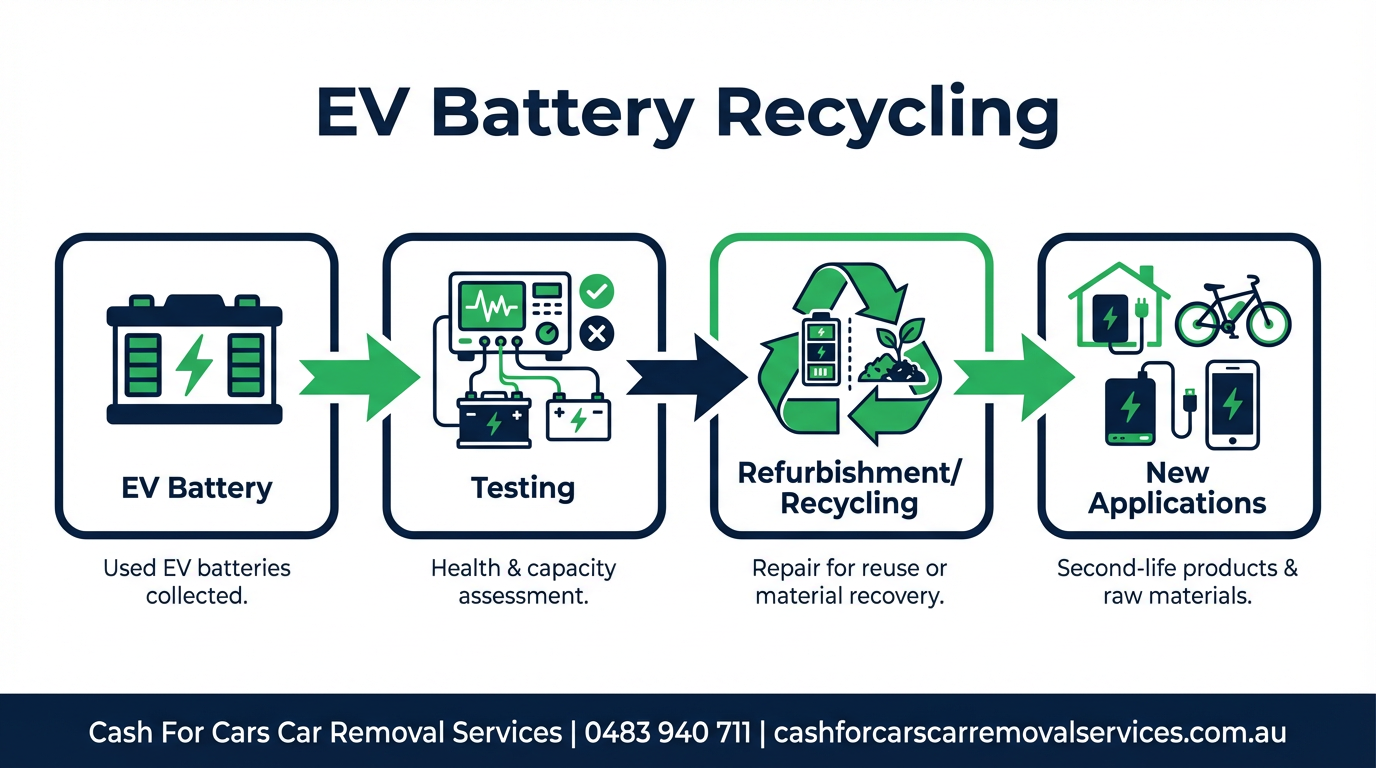
The EV Battery Lifecycle
Stage 1: First Life (Vehicle Use)
Stage 2: Second Life (Repurposing)
- Home energy storage
- Grid stabilisation
- Solar power storage
- Commercial backup power
Stage 3: Recycling
When batteries no longer hold useful charge:
Mechanical recycling:
Hydrometallurgical recycling:
Pyrometallurgical recycling:
Current State of EV Recycling in Australia
Challenges
Progress
Selling Your Electric Vehicle
If Your EV Still Runs
Options:
Important factors:
If Your EV Battery is Degraded
Don't worry — value remains:
Cash for EVs: We buy electric vehicles in any condition, including those with degraded or failed batteries.
If Your EV is Accident Damaged
Safety first:
We handle it: Our team is trained in safe EV recovery. Call us for damaged EV removal.
Environmental Benefits of Proper EV Recycling
Resource Conservation
Recycling EV batteries:
Emissions Reduction
Proper recycling:
What Happens to Your EV After Sale
When you sell your EV to us:
EV Selling Tips
Before You Sell
What We Need
Ready to Sell Your Electric Vehicle?
Cash For Cars Car Removal Services buys all electric vehicles:
We offer:
Call 0483 940 711 for your EV quote today!